
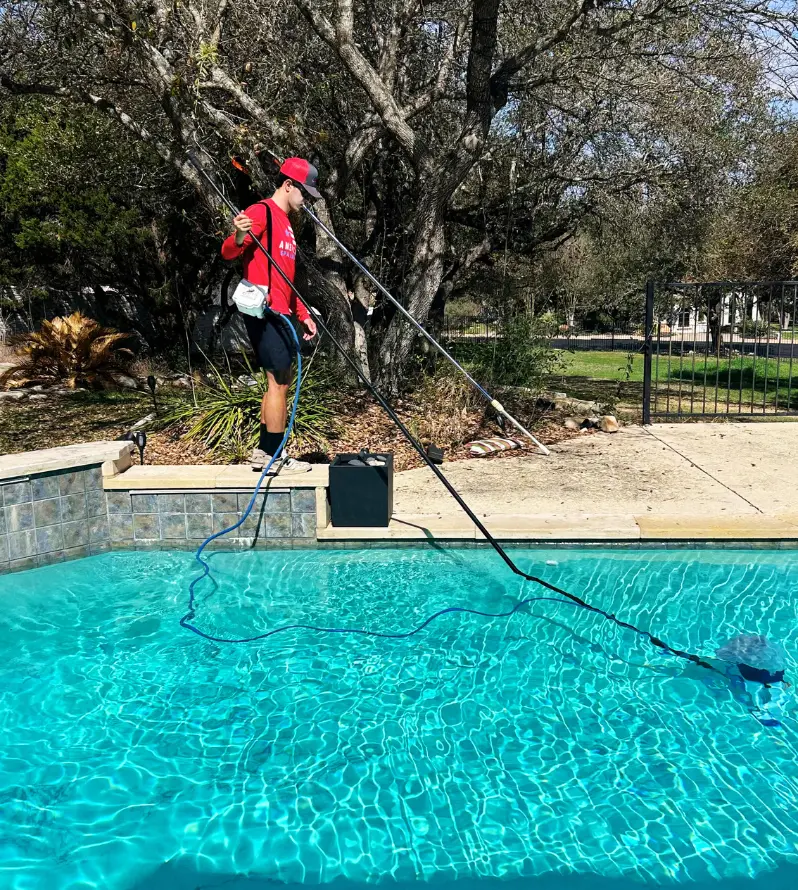

Owning a swimming pool in Austin sounds pretty simple.
Keep the water clean. Add some chlorine. Run the pump. Skim out the leaves. Enjoy the pool.
Easy, right?
Well… sort of.
The truth is that pool care mistakes are incredibly easy to make, even when you’re trying to do everything correctly. A pool can look perfectly fine one week and suddenly turn cloudy, develop algae, or start showing equipment problems the next.
Austin makes things a little more challenging, too.
Strong Texas sun, heat, pollen, dust, storms, evaporation, and a long swimming season can put extra pressure on your pool and its equipment. Current Austin pool-care guidance points to heat, hard water, pollen, evaporation, and sudden freezes as some of the local conditions homeowners need to keep in mind.
The good news?
Most common pool maintenance mistakes are avoidable.
Let’s look at the ones that cause the most trouble and what you can do instead.
1. You’re Adding Pool Chemicals Without Testing the Water
This is one of the biggest pool care mistakes homeowners make.
You look at the water and think, “It seems a little off.”
So you add chlorine.
Then maybe some pH increaser.
Then a little more chlorine.
Before long, you’re guessing your way through water chemistry.
That’s not a great strategy.
Clear-looking water doesn’t necessarily mean the chemistry is balanced. And cloudy water doesn’t tell you exactly which chemical is missing.
Your pool water should be tested before you start making adjustments.
Important measurements can include:
- Free chlorine
- pH
- Total alkalinity
- Cyanuric acid
- Calcium hardness
- Salt level, if you have a saltwater pool
The exact targets depend on your pool and the equipment you’re using.
Why does this matter so much?
Water that’s out of balance can lead to cloudy water, algae, scaling, corrosion, uncomfortable swimming conditions, and unnecessary strain on equipment.
And Austin’s heat can make things move quickly.
The better approach is simple: test first, then treat.
Don’t let a guess turn into a chemistry experiment.
2. You’re Not Cleaning the Pool Consistently
Another common mistake is assuming the pool only needs attention when it looks dirty.
Unfortunately, that’s not how pool maintenance works.
Leaves, pollen, dust, bugs, sunscreen, and other contaminants can enter the pool long before you notice a visible problem.
Austin’s outdoor conditions make this especially important. Local pool-care guidance notes that pollen, dust, and heat can create daily maintenance demands for Austin homeowners.
A good cleaning routine may include:
- Skimming the surface
- Emptying skimmer baskets
- Emptying the pump basket
- Brushing pool walls
- Vacuuming the floor
- Checking water chemistry
- Inspecting circulation
- Checking the filter
You don’t necessarily need to perform every task every day.
But you do need consistency.
A few minutes of routine maintenance is usually much easier than dealing with a green pool after several missed weeks.
3. You’re Ignoring the Pool Filter
Your filter doesn’t get much attention when it’s working correctly.
That’s exactly why it’s easy to forget.
But your pool filter is one of the most important pieces of the circulation system. It removes suspended particles and helps keep the water clear.
One of the biggest pool filter maintenance mistakes is waiting until the water becomes cloudy before checking it.
Pay attention to the filter pressure gauge.
If pressure is consistently higher than the normal clean-filter starting pressure, the filter may need cleaning or other attention. The correct pressure range depends on the specific filter, so follow the manufacturer’s instructions rather than relying on a universal number.
Also watch for:
- Reduced water flow
- Cloudy water
- Frequent pressure increases
- Damaged filter cartridges
- Unusual equipment behavior
And don’t assume a filter that looks clean is necessarily performing well.
Sometimes the problem isn’t obvious until you look at the whole circulation system.
4. You’re Running the Pump for Too Little Time
Your pool needs circulation.
That’s not optional.
The pump moves water through the filtration and sanitation system, helping distribute chemicals and remove debris.
A common mistake is reducing pump runtime simply because you’re trying to save electricity.
That may seem sensible.
But if the water isn’t circulating enough, you can end up paying for the consequences later.
Poor circulation can contribute to:
- Uneven chemical distribution
- Cloudy water
- Debris buildup
- Algae growth
- Poor filtration
- Extra equipment strain
There’s no single pump schedule that’s perfect for every Austin pool. Pool size, pump type, plumbing, filter, weather, water temperature, and usage all matter.
Rather than copying your neighbor’s schedule, make sure your system is actually getting enough circulation.
5. You’re Letting Small Pool Problems Become Big Ones
Here’s a frustrating truth about pool ownership:
Small problems rarely become more convenient when you ignore them.
Maybe the water is slightly cloudy.
Maybe the pump makes a strange sound.
Maybe the pressure gauge suddenly reads differently.
Maybe you notice the water level dropping faster than usual.
You think, “I’ll deal with it this weekend.”
Then the weekend gets busy.
And suddenly that small issue has become an expensive repair.
Austin Water recommends regularly checking pools for leaks and suggests marking the water level at the skimmer, then checking it again after 24 hours. If the pool loses more than ¼ inch of water, the city advises checking for a leak.
That’s a useful habit.
Don’t panic over every small change. Just don’t ignore repeated changes either.
Early attention can save a lot of frustration.
6. You’re Forgetting About Austin’s Sun and Heat
Texas sunshine is fantastic for pool days.
Your pool equipment may have a different opinion.
Strong sunlight can affect chlorine levels, while high temperatures increase evaporation and can make maintaining water chemistry more demanding.
Austin’s long swimming season also means your pool may be working hard for much of the year.
That creates another common pool care mistake: treating summer maintenance like the rest of the year.
Your pool’s needs can change with the weather.
During hot periods, keep a closer eye on:
- Water level
- Chlorine
- pH
- Filter pressure
- Debris
- Pool temperature
- Equipment operation
Austin Water recommends maintaining proper chemical levels and adequate circulation time, and using a pool cover to reduce evaporation and chemical use.
A cover isn’t magic, but it can make a noticeable difference.
7. You’re Not Paying Attention After a Big Storm
A storm can change your pool surprisingly quickly.
Wind blows leaves and dirt into the water. Rain can dilute chemicals. More debris may end up in the skimmer and filter.
And if the storm is followed by hot weather?
That’s a recipe for trouble if you don’t check the pool.
After a significant storm, take a few minutes to:
- Remove large debris.
- Check the skimmer and pump baskets.
- Inspect the water level.
- Test the water.
- Check circulation.
- Inspect the equipment area.
- Look for anything unusual.
Don’t automatically dump a bunch of chemicals into the pool just because it rained.
Test first.
Then make the adjustment the water actually needs.
8. You’re Treating Your Pool Filter Like a Garbage Can
This one sounds strange, but hear me out.
Your filter is designed to catch contaminants.
That doesn’t mean it should be ignored until it’s completely packed with debris.
A clogged or neglected filter has to work harder, and poor filtration can affect water clarity and circulation.
Another mistake is backwashing or cleaning the filter simply because it’s been a certain number of days.
Austin Water specifically advises homeowners to backwash pool filters only when needed and suggests manually cleaning the filter when appropriate.
There’s also a local environmental issue to remember.
Austin Watershed Protection says pool and spa discharges can contain pollutants and that it is illegal to discharge pool filter backwash to a storm drain, street curb, or waterway. The city recommends allowing backwash to soak into a vegetated area on your property.
So don’t simply point the backwash hose toward the nearest storm drain and call it done.
Local rules matter.
9. You’re Ignoring Your Pool’s Water Level
Water level might seem like a minor detail.
It isn’t.
Your pool needs enough water for the skimmer and circulation system to operate correctly.
Austin’s heat can cause significant evaporation, especially during the hottest parts of the year. A low water level can interfere with circulation and may cause the pump to pull air instead of water.
That can create bigger equipment problems.
At the same time, constantly adding water without understanding why the level keeps dropping isn’t ideal either.
Some water loss is normal.
Too much may point to:
- Excessive evaporation
- Splash-out
- A leak
- An autofill problem
- Plumbing issues
If you find yourself adding water again and again, investigate the reason rather than treating the symptom.
10. You’re Forgetting About Hard Water and Scale
Austin homeowners may also have to deal with hard water and mineral buildup.
When water chemistry isn’t properly managed, calcium deposits can develop on tile, pool surfaces, and equipment.
You may notice:
- White or chalky deposits
- Rough surfaces
- Scale around water features
- Reduced equipment performance
- Deposits around fittings
A recent Austin pool-owner guide highlights hard water, evaporation, and scale as local concerns.
The solution isn’t simply scrubbing harder.
Keep an eye on calcium hardness and overall water balance, and address scaling before it becomes a much larger cleanup project.
11. You’re Only Thinking About the Water
Here’s a mistake that catches people off guard.
They focus on the water because that’s what they see.
But a swimming pool is a system.
Your pump, filter, heater, valves, plumbing, cleaner, lights, cover, and other components all play a role.
If the water looks fine but the pump sounds different, don’t ignore it.
If the water is clean but the filter pressure keeps climbing, investigate it.
If the pool is balanced but circulation is weak, there may be an equipment issue.
Regular equipment checks can catch problems before they become major repairs.
You don’t have to become a pool technician.
You just need to pay attention.
12. You’re Taking a Break From Pool Care During the Cooler Months
Austin doesn’t have a typical northern winter, but that doesn’t mean your pool gets a free pass.
The area can experience sudden freezes, and freeze damage can be especially hard on exposed pool equipment and plumbing.
Local Austin pool guidance recommends preparing for freeze conditions and keeping equipment protected.
The mistake is assuming:
“It’s not swimming season, so I don’t have to think about the pool.”
Actually, the opposite can be true.
When temperatures drop, keep an eye on freeze protection, equipment operation, water level, and the condition of exposed plumbing.
A short cold snap can create a surprisingly expensive problem if the equipment isn’t prepared.
So, What Should Good Pool Care Look Like?
The good news is that you don’t need to spend your entire Saturday working on your pool.
Good pool care is mostly about consistency.
A simple routine might include:
Regularly: skim debris and check the pool’s general condition.
Weekly: test water, clean surfaces, empty baskets, and inspect circulation.
As needed: clean the filter, adjust chemicals, inspect equipment, and deal with unusual water loss.
After major storms: remove debris and retest the water.
During extreme heat: pay closer attention to evaporation, chlorine, water level, and equipment.
Before freezing weather: make sure your pool equipment is ready.
The exact routine depends on your pool, equipment, usage, and local conditions.
DIY Pool Care vs. Professional Pool Service
There’s nothing wrong with taking care of your own pool.
For many homeowners, it’s part of the fun.
The trouble starts when maintenance becomes inconsistent or when a problem gets beyond your comfort level.
Professional pool maintenance in Austin can be helpful if:
- You travel frequently.
- Your pool gets heavy use.
- You don’t have time for weekly maintenance.
- Water chemistry is difficult to keep balanced.
- You’re dealing with recurring algae.
- Equipment isn’t working properly.
- You aren’t sure whether the problem is chemical or mechanical.
- You simply don’t want pool maintenance on your weekend schedule.
The goal isn’t to hand every little task to someone else.
It’s to make sure the pool gets the attention it needs.
A Simple Austin Pool Care Mistakes Checklist
Before you call it a day, ask yourself:
Did I test the water before adding chemicals?
Is the filter pressure normal?
Is the pump circulating properly?
Are the skimmer and pump baskets clear?
Is the water level normal?
Did a recent storm bring in extra debris?
Have I noticed any leaks, strange noises, or unusual equipment behavior?
Is my pool prepared for the current weather?
If you can answer those questions confidently, you’re already avoiding many of the biggest pool maintenance mistakes.
The Biggest Pool Care Mistake? Being Inconsistent
You don’t need to be perfect.
Really.
One missed cleaning isn’t going to destroy your pool.
One rainy weekend won’t automatically create an algae outbreak.
The problem is when small things keep getting ignored.
A missed test becomes a chemistry problem.
A clogged filter becomes poor circulation.
A strange pump noise becomes an equipment failure.
A small leak becomes a much larger water-loss problem.
That’s why consistency matters more than perfection.
Austin’s climate gives your pool plenty to deal with already. Your maintenance routine doesn’t need to make the job harder.
Keep Your Austin Pool Healthy Without the Guesswork
Pool ownership should be about enjoying the water not constantly wondering why the water turned cloudy overnight.
Avoiding common pool care mistakes starts with a few basic habits: test before adding chemicals, clean consistently, keep water circulating, watch your filter, check equipment, monitor water levels, and pay attention to Austin’s weather.
And when something doesn’t look right, don’t wait weeks hoping it’ll fix itself.
American Spa and Pool Service, A.S.A.P. provides professional pool care and equipment services for homeowners in the Greater Austin area. If your pool needs regular maintenance, filter care, equipment attention, or help getting an ongoing problem under control, professional service can take some of the guesswork out of pool ownership.
A clean pool is great.
A pool that stays clean without becoming a constant headache?
Even better.